A 25-minute browser game · Voyager 1 · 14 February 1990

Turn the
Camera Home

Voyager 1 is six billion kilometres from Earth. Its cameras are about to shut down forever. You have one chance to turn them back toward home.

Begin the mission Free · no account · desktop or phone · sound recommended
Story the Pale Blue Dot Role mission team + Voyager Structure five connected acts Install none
What this is

Turn the Camera Home is an interactive retelling of how Voyager 1 captured the Pale Blue Dot. Across five connected acts, you play the people who fought for the picture — and the spacecraft that had to take it.

What you will do

Win approval for one last look back. Use gravity to reach interstellar space, work inside a failing power budget, expose the Family Portrait, and fight for enough antenna time to bring the frames home. Your choices follow you into the ending.

The plan
Step one
Win approval

Find the argument that moves each member of the mission team before the window closes.

Step two
Fly the mission

Tune Voyager's departure, skim Jupiter, pass Saturn, and leave the solar system.

Step three
Take the portrait

Balance power, protect the camera, sweep the sky, and locate Earth inside the glare.

Step four
Bring it home

Book the Deep Space Network, assemble the data, and find Earth again in the noise.

Play the whole mission in about 25 minutes

Your decisions move forward from the Pasadena argument to the moment Earth appears on a screen.

Begin the mission
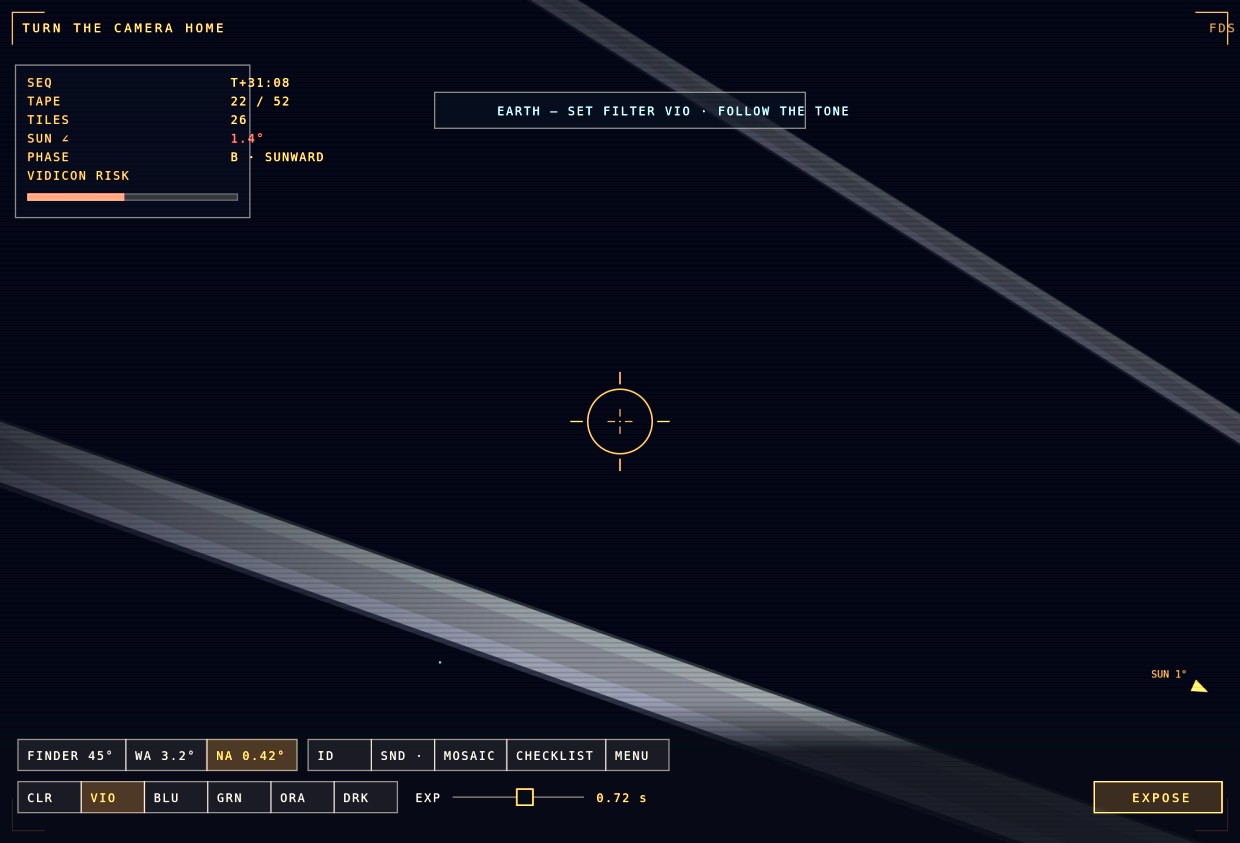
Narrow-angle view 1.4 degrees from the Sun, with scattered-light rays crossing the frame
Act III · 1.4° from the Sun

Rays of sunlight scattered inside the camera cross the whole field. Home waits somewhere in there, smaller than the optics can honestly resolve, and a rising tone is the only thing that will lead you to it.

How the mission plays

The rules change as the mission changes jobs. Each act teaches its controls, and your decisions carry into later scenes.

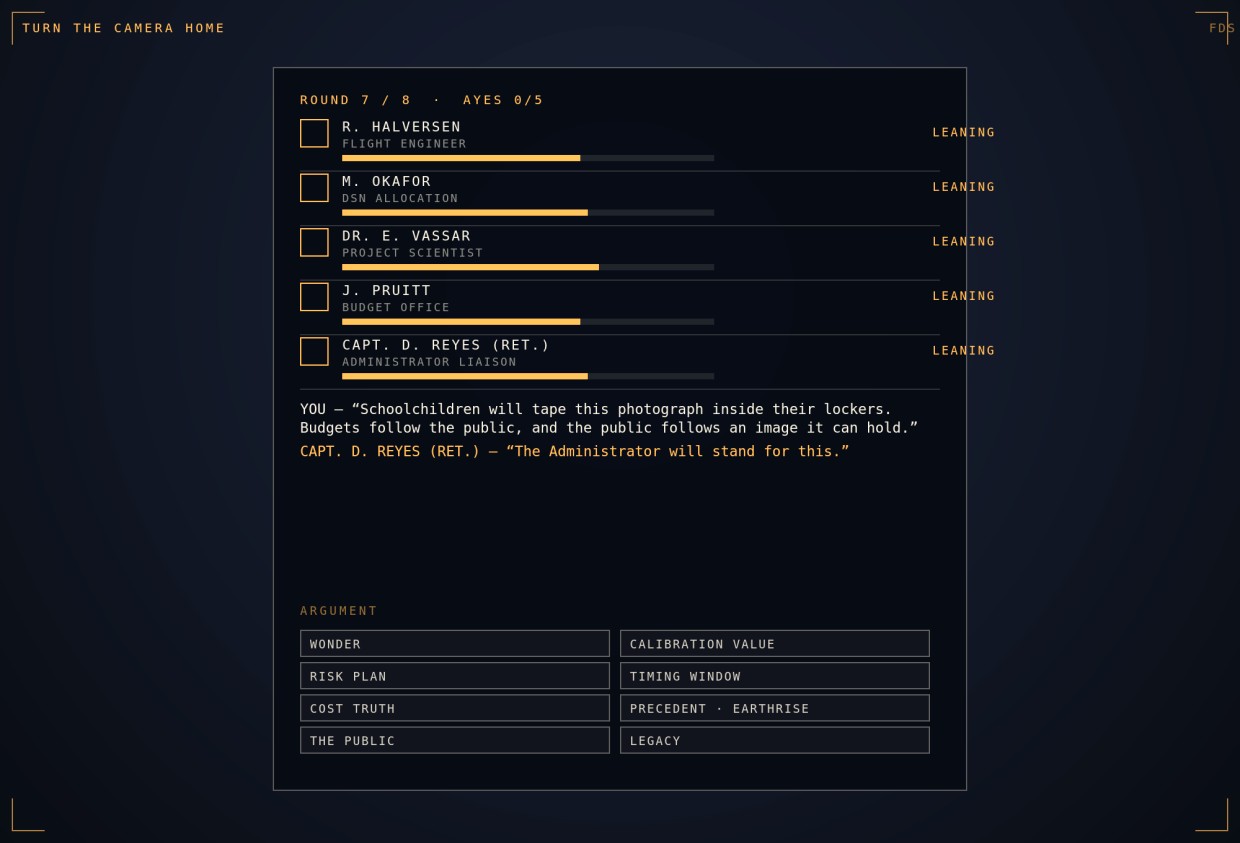
Meeting panel showing five staff members with persuasion meters
Act I — round seven, the room still leaning
Act I

The Argument

Pasadena, December 1989. Eight rounds, eight arguments, five people who each need a different reason. The flight engineer will not budge until you answer his objection about sunlight in the tube, and that objection unlocks the only card that can satisfy him. Surplus persuasion becomes priority chits you spend on antennas two acts later.

How it plays

Pick an argument, pick a listener, and watch the room move. Repeat a line and it wears out. Win three of five for approval.

The history

Carl Sagan pressed for the look-back photograph from about 1981. Engineers feared for the optics. Administrator Richard Truly, a former Navy rear admiral, gave the order.
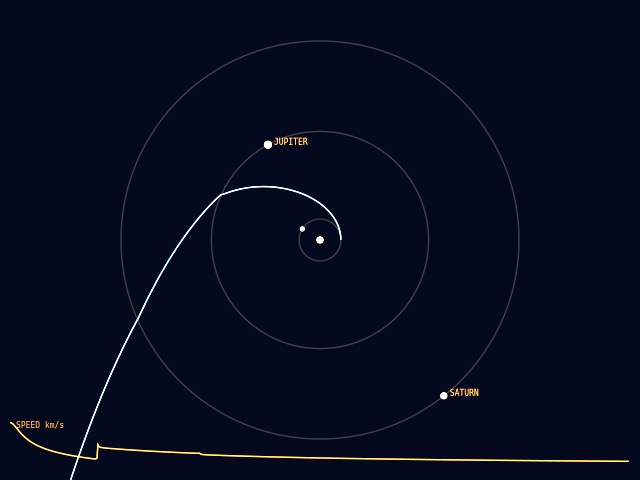
Trajectory plot with the spacecraft path curving past Jupiter and out of the solar system
Act II — the 1977 solution, flown live
Act II

Gravity is a Gift

Set your departure speed and aim, then watch a real integrator carry you outward year by year. Arrive close to Jupiter and the giant hands you kilometres per second for free. Momentum still balances: over the next century Jupiter slows by less than the width of one atom.

How it plays

Four sliders and a simulate button. Clear Jupiter under 0.05 AU, reach Saturn, and finish with positive orbital energy.

The history

Voyager 1 passed Jupiter around 350,000 km out in March 1979, then took a Saturn path threading past Titan — the choice that lifted it above the plane of the planets.

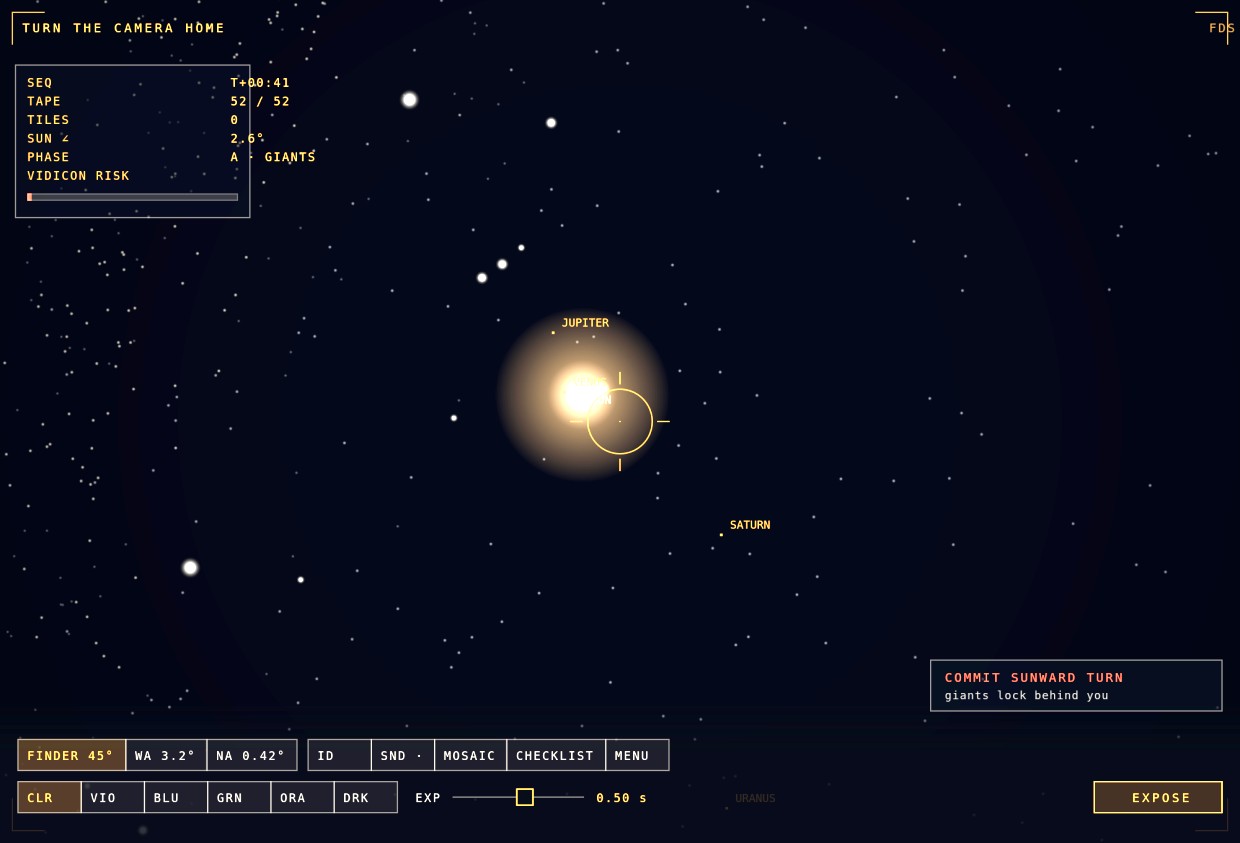
Wide finder view of the sky with the Sun's glow and labelled planets
Act III — finder, 45°, giants first
Act III

Sixty Frames

The centrepiece. Before anything moves you balance a power budget: 385 watts from decaying plutonium, 262 already claimed by the bus and radio, and a platform that wants more than what remains. Something goes quiet so the cameras can speak, and your choice returns in the epilogue.

How it plays

Drag to slew, with real inertia that grows heavier as the field narrows. Three optics, six filters, one exposure slider, fifty-two slots of tape.

The history

Each camera was a slow-scan vidicon behind a filter wheel, reading an 800-line frame over 48 seconds. Fields of view measured 0.424° and 3.2°.

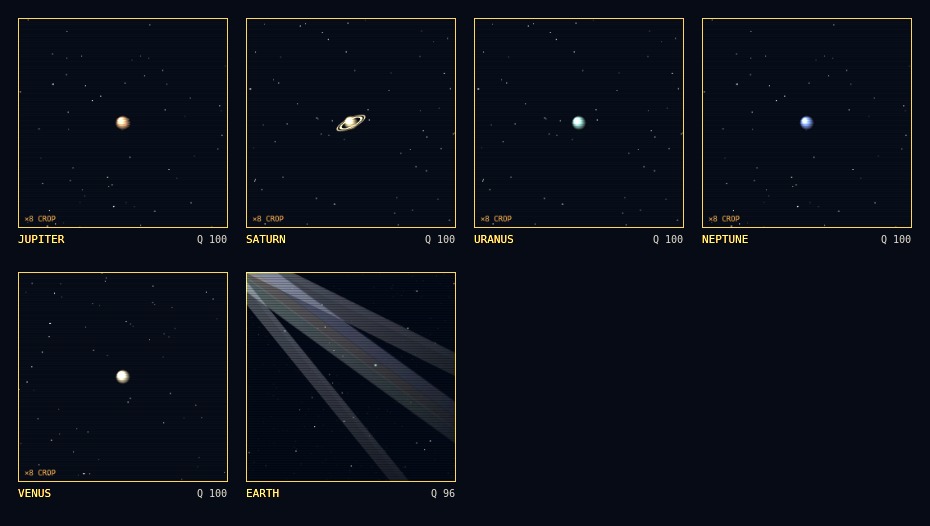
Contact sheet of narrow-angle frames showing Jupiter, Saturn, Uranus, Neptune, Venus and Earth
Your tape, developed — magnified crops of six worlds
Act III · on tape

What You Actually Catch

Every exposure is judged against the light that target really offers. Blow it and the review card shows the smear before asking whether to keep the frame or spend more tape on a retake. A star field far from the Sun earns a calibration bonus, while three worlds stay unphotographable no matter what you try.

Kept honest

Mercury hides in the glare, Mars thins into scattered light, and Pluto is thousands of times too faint. The checklist names each one and why.

The history

The finished portrait holds 60 frames: 39 wide-angle tiles sketching the arc, with narrow-angle close-ups of six planets set into them.

Deep Space Network illustration with three dishes on a turning Earth
Act IV — 40.4 AU, one-way light time 5 h 36 m
Act IV

Three Ears, One Turning World

The picture exists only on magnetic tape, five and a half light-hours away. Twelve weeks of passes across Goldstone, Madrid, and Canberra return 40 Mbit each, and rival missions already hold the slots you want. Chits earned in the meeting let you bump them, at a cost in goodwill.

How it plays

Fill a 3 × 12 grid while low-elevation windows lock you out. The week you finish sets a line in the epilogue.

The history

Frames trickled home through the Deep Space Network while sharing time with Magellan at Venus and Galileo in checkout. The last data arrived in May 1990.

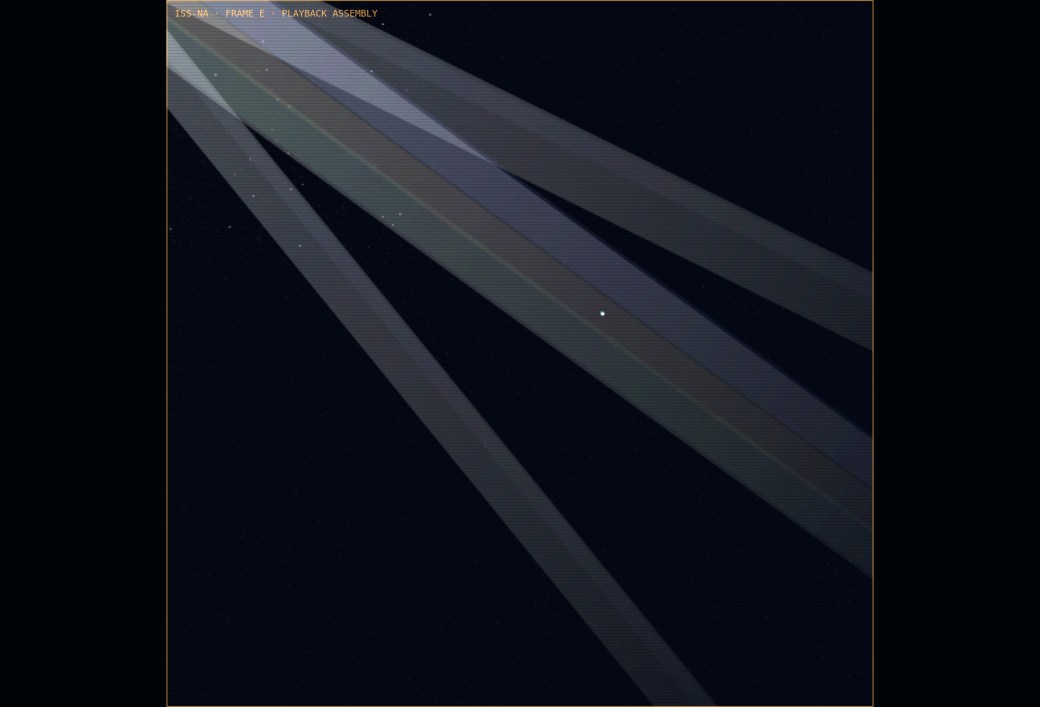
A noisy image assembling line by line on a monitor
Spring 1990 — the frame assembles, and someone has to find it
The bridge

The Light Arrives

Playback finished, you stop being the spacecraft. Rows of grey arrive on a monitor in Pasadena, and the game asks you to find home a second time — now in the noise, with no tone to guide you. Your two hunts rhyme across the whole story: once as the machine, once as a person leaning toward a screen.

How it plays

Tap where home should be. Miss twice and a soft circle narrows the search, the way a colleague would lean over and point.

The history

Nobody knew whether the sequence had worked until the data came down. The spacecraft did all of it alone, its confirming signal still hours from any antenna.

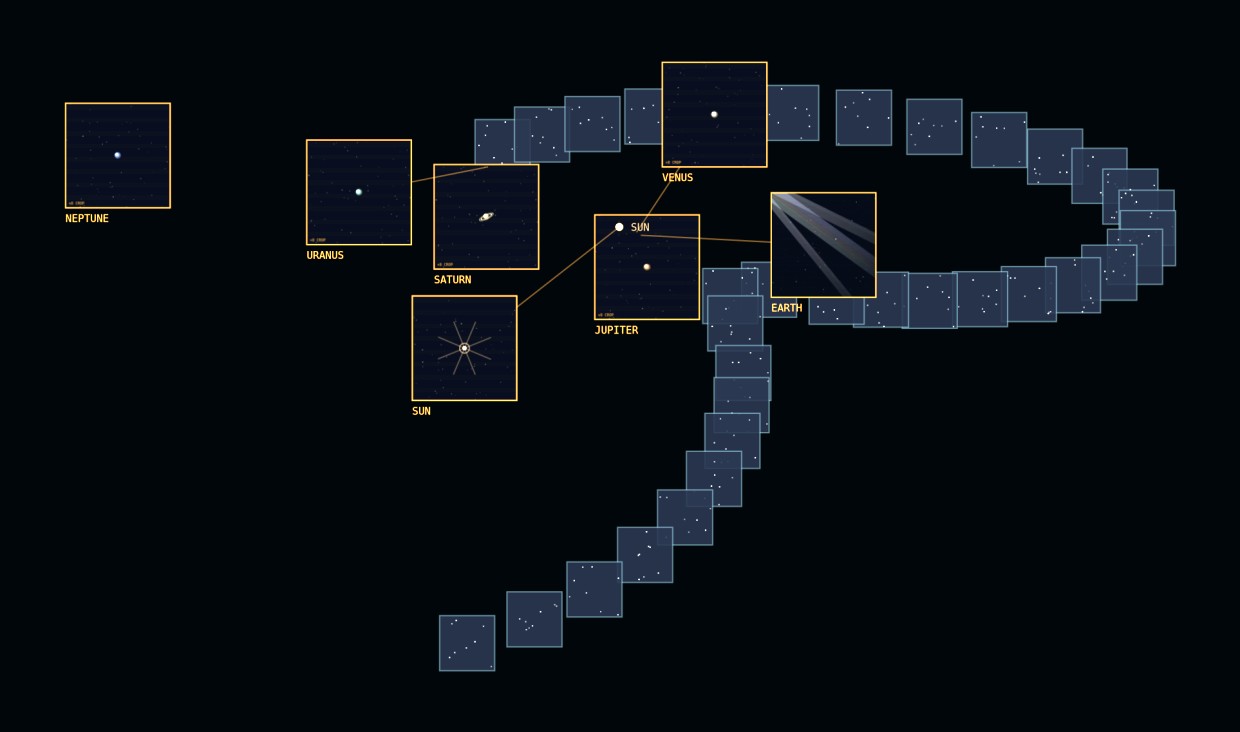
The assembled family portrait: an arc of mosaic tiles with labelled planet insets
Act V — your own family portrait, laid out from your sweep
Act V

The Dot

Your tiles fade in one by one, and the insets you earned drop into the arc with leader lines toward where each world truly sat. Tap the Earth frame and the camera falls slowly toward a single point while a reflection types itself out. The epilogue adapts to your run: the instrument you switched off, the haze you may have burned into the optics, the month your playback ended.

What you keep

Save the portrait as a 1080 × 1350 image, wander the Free Sky with constellation lines on, or read fourteen archive entries.

The history

Once the portrait was safe, both cameras were commanded off to bank power for the interstellar years. They have never taken another picture.

Actual size
one whole pixel

The mark inside that frame is a single pixel on your screen, and it is roughly eight times too generous. Earth covers about 0.12 of one pixel in the original photograph — a smear of pale blue that a careless eye reads as noise and a careful one reads as everyone.

the dot, magnified

Every person you have heard of, every argument ever won, every war and every kindness, happened on that fraction of a pixel.

Built on the real numbers

Where the simulation simplifies, it says so out loud.

Star fieldAbout 95 catalogue stars placed by right ascension and declination, sized by magnitude and tinted by spectral class, over a Milky Way that thickens toward the galactic centre.
OpticsNarrow angle 0.424°, wide angle 3.2°, six filters, and slew rates that slow as the field narrows.
Vantage pointRoughly 40 AU from the Sun and some 30° above the plane of the planets, with worlds placed from their orbital periods and epoch longitudes.
Power385 W available, 262 W held by the bus and radio, nine switchable loads that must fit the remainder.
TrajectoryFourth-order Runge–Kutta in AU and years, with Jupiter and Saturn perturbing the path. The historical preset lands near 400,000 km at Jupiter.
Downlink40 Mbit per booked pass across three stations over twelve weeks, with low-elevation windows closed off.
SpacecraftModelled at one unit per metre: 3.66 m high-gain dish, 1.78 m ten-sided bus, three finned generators, a 13 m magnetometer mast, and paired 10 m antennas in a right-angle V.
SoundGenerated live in the browser — a low pad, filtered noise, and a proximity tone that quickens as the reticle closes on Earth.

What actually happened

Fourteen entries like these ship inside the game's archive.

1977

Voyager 1 leaves Earth on a Titan IIIE-Centaur, a launcher descended from an intercontinental missile, carrying a gold-plated record of greetings and music.

circa 1981

Soon after the Saturn flyby, Carl Sagan begins urging a photograph looking back at Earth. Worry about pointing a camera so near the Sun keeps the idea waiting most of a decade.

1989

NASA Administrator Richard Truly approves the sequence. Imaging scientists Candice Hansen and Carolyn Porco work out the commands and exposures that become the Family Portrait.

14 February 1990

From about six billion kilometres, the platform sweeps the whole solar system in 60 frames. Earth lands inside a ray of sunlight scattered within the camera, covering roughly 0.12 pixel.

Spring 1990

The frames come home slowly through the Deep Space Network, sharing antenna time with two other missions. The last data arrives in May.

Afterward

The cameras are switched off to save power and memory for the interstellar years, and never take another picture.

1994

Sagan's book gives the image the words most people now remember it by.

Today

Voyager 1 is beyond 165 astronomical units and still receding about 17 kilometres every second, with the portrait pointed the other way.

a mote of dust suspended in a sunbeam
Carl Sagan · Pale Blue Dot · 1994

Take Voyager's final look back

No account and no install. Use sound if you can; the proximity tone helps you find Earth.

Begin the mission